
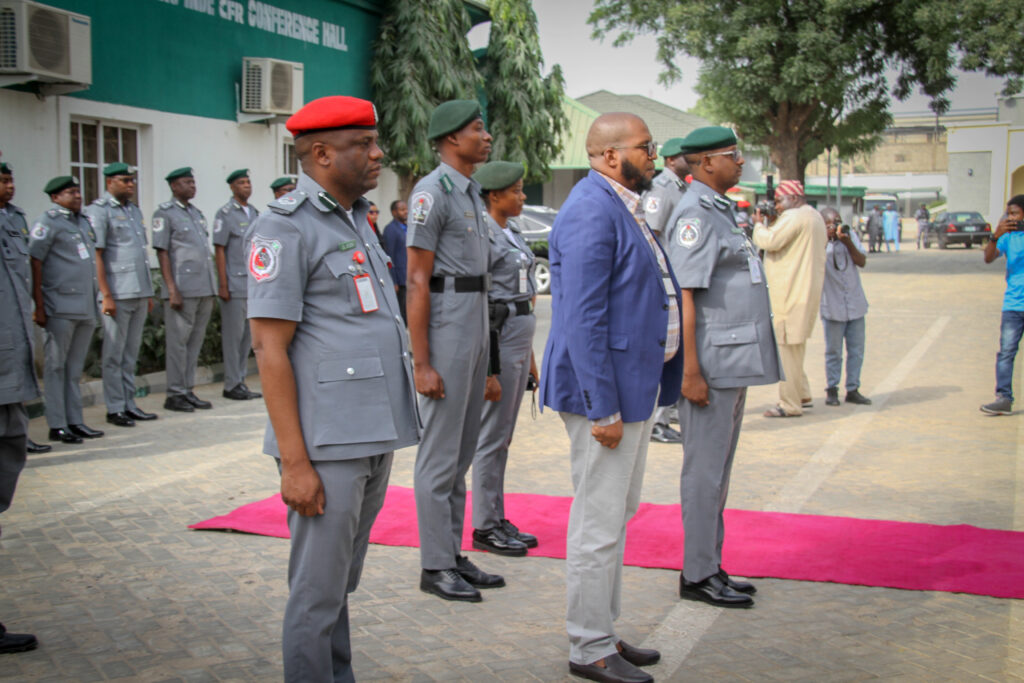
The Acting Area Controller of the Kano/Jigawa Area Command, Deputy Comptroller of Customs, Usman Adamu, has assured stakeholders and the business community of sustained engagement and cooperation, declaring that his administration remains committed to strengthening collaboration in line with the policy direction of the Comptroller-General of Customs, Bashir Adewale Adeniyi.
DC Adamu gave the assurance on Wednesday, 21 January 2026, during a stakeholders’ engagement at the Headquarters of Kano/Jigawa Area Command barely 24 hours after the Zonal Coordinator in charge of Zone ‘B’, Assistant Comptroller-General of Customs, Nsikan Umoh’s official visit to the Command.
Addressing stakeholders at the Abdullahi Dikko Inde Conference Hall, the Ag. CAC said his leadership would be guided by the three policy thrusts of the Comptroller-General of Customs: consolidation, collaboration and innovation, noting that dialogue and mutual understanding remain critical to effective Customs operations.
“My doors are always open to stakeholders. We can only achieve our mandate through collaboration, trust and continuous engagement.” DC Adamu said.
He urged importers, licensed Customs agents and other players in the logistics chain to take advantage of existing trade facilitation tools, stressing that compliance remains the foundation for smooth operations and mutual benefit.
Earlier on Tuesday 20 January, 2026, the Zonal Coordinator, Zone ‘B’, Assistant Comptroller-General of Customs, Nsikan Umoh, described the engagement as strategic, saying it provided a platform for strengthening cooperation between the Nigeria Customs Service and its stakeholders.
“This platform offers a critical opportunity for deepening collaboration between the Service and its stakeholders. Such partnership is indispensable to the realisation of our mandate and national economic development.” ACG Umoh said.
She highlighted several trade facilitation initiatives introduced by the Service in the last two years, including the Authorised Economic Operator scheme, advance ruling mechanisms, pre-arrival processing, overtime cargo clearance, one-stop-shop operations, transit tracking systems and the motor vehicle verification platform.
ACG Umoh stressed that the Kano/Jigawa Area Command occupies a strategic position as a commercial gateway to Northern Nigeria and a vital link in the trans-Saharan trade corridor, making compliance and procedural discipline imperative.
She, however, expressed concern over reported cases of cargo diversion, sabotage of transit goods and other infractions along the Kano–Kaduna corridor, warning that such practices undermine operational integrity and erode trust.
“Compliance saves time, reduces cost and protects legitimate trade. Non-compliance leads to sanctions and disruptions that affect everyone.” She warned.
The Zonal Coordinator disclosed that the Comptroller-General of Customs has directed the strict application of sanctions against any erring officer or stakeholder, adding that enforcement actions had already commenced within the Zone.
Speaking on behalf of licensed agents, the Chairman of Licensed Customs Agents in Kano, Hafiz Ridwan, acknowledged ongoing challenges associated with manual application processes, expressing confidence that administrative reforms and improved controls would address the gaps.
“For now, applications will originate strictly from Kano, with advanced copies transmitted through official service channels to the ports. This will help us maintain control and filter out non-compliant operators.” He said.
He added that approved containers would be monitored through the IM5 application, while daily approvals would be shared with the Command to enhance transparency and compliance.