
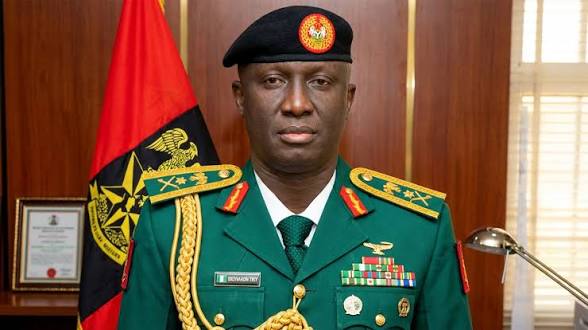
Special Report: From FANSAN YANMA to HADIN KAI, troops are dismantling criminal networks, rescuing civilians and reclaiming communities
By Blazon News Nigeria
Nigeria’s battle against terrorism, banditry and other violent crimes is witnessing a new operational momentum, and at the heart of that renewed push is the Nigerian Army under the leadership of Chief of Army Staff, Lieutenant General Waidi Shaibu.
Since assuming office, Shaibu has pursued a command philosophy centred on building a more professional, adaptable, combat-ready and resilient force. The approach has combined intelligence-led operations, improved coordination, stronger surveillance, modern combat platforms and a deliberate effort to place the welfare and effectiveness of soldiers at the centre of military operations.
For Blazon News Nigeria, the most compelling evidence of this evolving strategy can be found not only in official briefings, but also in the series of operations our newsroom has followed across the country’s security theatres—particularly Operation FANSAN YANMA, where troops have maintained sustained pressure against terrorists and bandits in the North-West.
FANSAN YANMA: Taking the Battle to the Enemy
Recent reports published by Blazon News Nigeria have tracked the determination of troops operating under FANSAN YANMA to pursue armed groups across difficult terrain and deny them the freedom to operate with impunity.
The operation has increasingly relied on intensified reconnaissance, surveillance and intelligence gathering to locate hostile elements, understand their movements and support ground forces in mounting offensive operations. The significance of that approach cannot be understated.
For years, forests and remote settlements across parts of the North-West provided criminal groups with hiding places from which they launched attacks, kidnapped civilians and rustled livestock. The sustained military pressure under FANSAN YANMA is changing that equation.
In one of the recent developments reported by Blazon News Nigeria, troops under the operation continued to record battlefield gains against terrorist and bandit elements, reinforcing the growing pressure on criminal networks operating across the region.
The Nigerian Army’s own assessment provides an even broader picture. According to Lt.-Gen. Shaibu, FANSAN YANMA operations within the period under review resulted in 1,717 bandits neutralized, 2,660 suspects arrested and 4,052 civilians rescued. Troops also recovered more than 527 AK-47 rifles and over 156,000 rounds of ammunition, significantly degrading the firepower available to criminal elements.
Those figures tell a story of sustained pressure but numbers alone do not adequately capture what is happening on the ground.
Every rescued civilian represents a family reunited. Every recovered rifle potentially prevents another attack. Every criminal hideout disrupted reduces the space available for terrorists and bandits to plan their next operation.
Beyond the Battlefield
The FANSAN YANMA campaign has also demonstrated that the Army’s response to insecurity is not limited to kinetic operations.
Reports followed by Blazon News Nigeria have highlighted the Civil-Military Cooperation component of military engagement in affected communities, including interventions supporting healthcare facilities and farmers. That dimension is critical because military victories become more meaningful when communities can return to normal life.
A farmer who can return to his field without fear is a security success. A child who can attend school safely is a security success. A community whose residents can travel freely without the fear of abduction is a security success.
The Army’s growing emphasis on civil-military cooperation also reflects the understanding that intelligence from local communities can be decisive in identifying criminal movements and preventing attacks.
The HADIN KAI Front
The same operational philosophy is visible in the North-East, where Operation HADIN KAI continues to confront Boko Haram and ISWAP terrorists.
According to figures provided by the Chief of Army Staff, operations in the North-East during the period under review resulted in 1,993 terrorists neutralised, 2,645 suspects arrested and 1,778 civilians rescued.
Troops also recovered hundreds of AK-47 rifles and tens of thousands of rounds of ammunition. The Army said these operations have contributed to the gradual stabilisation of the region and enabled displaced communities to begin returning home.
For an insurgency that has lasted for more than a decade, such progress is significant. The battle, however, remains ongoing.
An Army Adapting to a Changing War
One of the clearest differences in the Army’s current approach is the growing role of technology and intelligence.
Modern warfare against terrorists and bandits requires more than conventional firepower. Criminal groups hide in forests, move between communities, exploit difficult terrain and constantly change tactics.
The Army has therefore expanded its use of modern platforms, including helicopters, protected vehicles and unmanned aerial systems, while strengthening communication and surveillance capabilities.
The COAS has also placed emphasis on indigenous innovation and local defence production as part of efforts to make the force more sustainable and operationally independent.
The Army’s Combat Support Arms Training Week in 2026 further underscored this direction, with the service highlighting indigenous innovation, research and technology as tools for improving battlefield effectiveness.
The Soldier First Factor
Behind every successful operation are soldiers who must endure the realities of the battlefield.
Shaibu’s command philosophy has therefore placed considerable emphasis on troop welfare, training and manpower development. The Army has reported investments in barracks, healthcare, education, insurance and housing for personnel and their families. More than 15,000 children of deceased personnel had benefited from the Army’s education sponsorship programme as of May 2026, while housing initiatives have also expanded.
The philosophy is straightforward: a soldier who knows that his welfare and family are being considered is better positioned to remain focused on the mission.
Success Across the Country
The gains under the current Army leadership are not confined to the North-East and North-West.
The Army reported operational successes across the North-Central, South-East, South-West and South-South theatres, involving the neutralisation and arrest of criminal elements, rescue of civilians, recovery of weapons and improved security along critical routes and national assets.
In the North-Central, operations including ENDURING PEACE, WHIRL STROKE and SAHEL SANITY have contributed to improved security, including along important transportation corridors.
In the South-East, Operation UDO KA has targeted criminal networks and cleared key enclaves, while operations in the South-West and South-South have focused on kidnapping, armed robbery, militancy, oil theft and other threats.
The cumulative picture is that of an Army attempting to maintain pressure on multiple fronts simultaneously.
A New Chapter for the Nigerian Army?
Lt.-Gen. Waidi Shaibu inherited an Army already engaged in complex operations across the country. His challenge has been to sharpen its effectiveness while adapting it to a rapidly changing security environment.
The evidence so far points towards an approach built around intelligence, technology, mobility, offensive operations, joint coordination, indigenous innovation and the welfare of troops and FANSAN YANMA offers perhaps one of the clearest windows into that transformation.
From the forests of Zamfara, Sokoto and neighbouring areas to the battlefields of Borno and the wider North-East, Nigerian soldiers continue to pursue those threatening the nation’s peace.
They have lost comrades. They have faced ambushes, difficult terrain and a determined enemy. Yet they continue to advance. For the Nigerian soldier, this is not simply another operation. It is a fight for the Nigerian family. A fight for the farmer who wants to return to his land. A fight for the traveller who wants to use the nation’s highways without fear. A fight for the child who deserves to grow up without knowing the sound of gunfire. And ultimately, it is a fight for the right of Nigerians to live in peace.
The Nigerian Army is no longer waiting for the enemy to choose the battlefield. Under Waidi Shaibu, the message from the frontlines is increasingly unmistakable: Nigeria’s soldiers are taking the fight to those threatening the nation.