
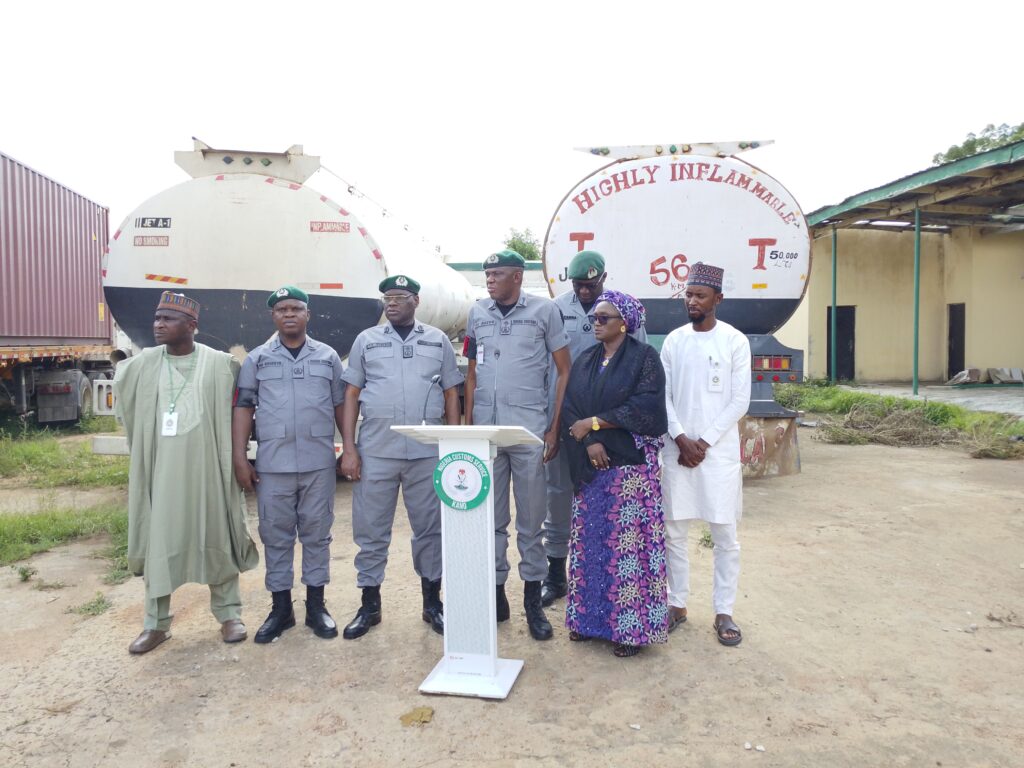
The Nigeria Customs Service (NCS), under Operation Whirlwind, has handed over two tanker trucks conveying suspected diverted Jet A1 (aviation turbine fuel) to the Nigerian Midstream and Downstream Petroleum Regulatory Authority (NMDPRA) for further investigation.
The handover, carried out in Kano on the directive of the Comptroller-General of Customs, Bashir Adewale Adeniyi, underscored the Service’s commitment to protecting Nigeria’s petroleum resources and combating economic sabotage through inter-agency collaboration.
Speaking during the exercise, the National Coordinator of Operation Whirlwind, Deputy Comptroller of Customs A.L Aliyu said the two tankers with registration numbers DKA-280-XY and T-174-11-LA were intercepted along Zaria Road on July 2, 2026, following credible intelligence and sustained surveillance by operatives.
According to Aliyu, preliminary investigations revealed that the aviation fuel was originally destined for Octavos and Siter Depot at the Nnamdi Azikiwe International Airport, Abuja, as indicated in the NMDPRA daily truck manifest.
“Suspicious circumstances surrounding the movement of the products prompted immediate interception over alleged diversion”.
He explained that Operation Whirlwind was established as a strategic national initiative to tackle the illegal diversion, smuggling, and cross-border trafficking of petroleum products and also aimed at safeguarding Nigeria’s energy security, protecting government revenue, and preventing supply chain leakages.
Abubakar noted that the successful interception highlighted the effectiveness of intelligence-driven operations and reaffirmed the government’s resolve to dismantle criminal networks involved in petroleum product diversion across the country.
Furthermore, the National Coordinator stressed that the handover would enable the NMDPRA to conduct detailed regulatory investigations, forensic verification of the products and accompanying documents, determine compliance with existing regulations, and apply appropriate sanctions where violations are established.
The Comptroller Described fuel diversion as a serious threat, that the crime goes beyond economic losses, warning that it endangers aviation safety, drains public revenue, distorts the petroleum supply chain, creates artificial scarcity, and undermines Nigeria’s energy security and critical infrastructure.
He reaffirmed that Operation Whirlwind would continue to deploy intelligence, surveillance, and strategic partnerships to detect, deter, disrupt, and dismantle petroleum-related economic crimes, while ensuring that offenders are brought to justice.
He commended the professionalism of officers involved in the operation and acknowledged the support of the Office of the National Security Adviser, led by Malam Nuhu Ribadu, as well as the leadership of Comptroller-General Bashir Adewale Adeniyi, for providing the strategic direction and resources that have strengthened the success of Operation Whirlwind.
On her part, the representative of the NMDPRA, Grace Dauda warned that every litre of diverted fuel deprives the nation of revenue, fuels artificial scarcity, and strengthens criminal networks.
She said the Authority, under the leadership of Malam Rabiu Asbelu Umar, has intensified surveillance of petroleum distribution through its loading manifest and truck-out data system, which is shared with the Nigeria Customs Service to track product movement and expose illegal diversion.
Dauda described the growing collaboration between both agencies as a major step in safeguarding the integrity of Nigeria’s petroleum supply chain while
calling on petroleum marketers and operators to strictly comply with NMDPRA regulations by ensuring products reach their approved destinations, stressing that the fight against fuel diversion requires the collective efforts of regulators, security agencies, industry players, border communities, and the public.
“Protecting Nigeria’s petroleum resources is a shared responsibility that will strengthen the economy, enhance national security, and guarantee energy availability for all Nigerians,” she said.